

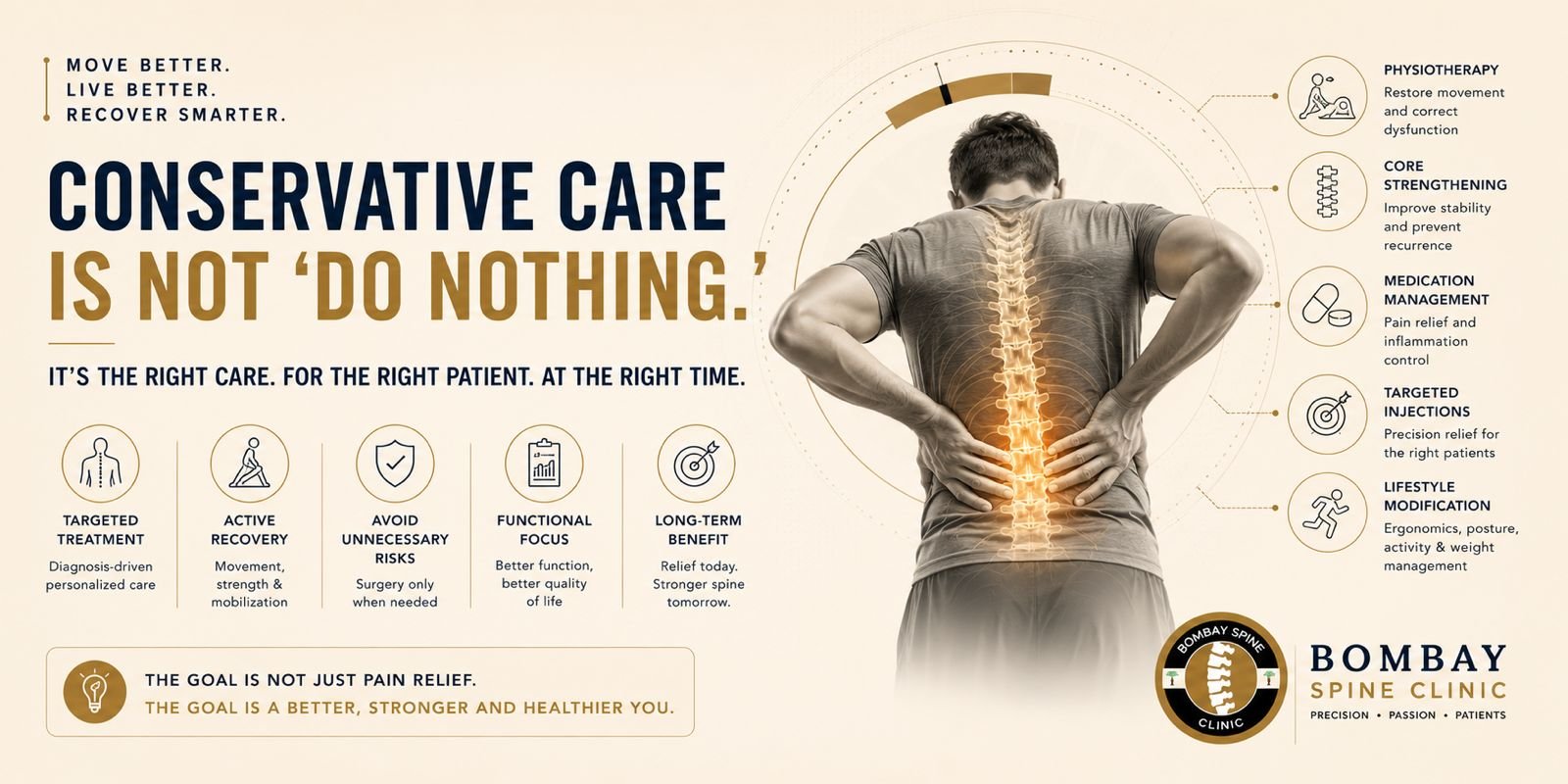
The Myth
One of the most damaging misconceptions in spine care is the belief that conservative treatment simply means “avoiding surgery” or “waiting it out.”
In reality, modern conservative spine management is an active, evidence-driven therapeutic strategy designed to:
Reduce pain
Restore mobility
Improve function
Prevent progression
Optimize long-term spinal health
Unfortunately, many patients are told one of two extremes:
You definitely need surgery.
Just do physiotherapy and tolerate it.
Both approaches oversimplify a highly nuanced clinical process.
The truth is:
Conservative care is not passive treatment. It is precision-guided rehabilitation.
The Evidence
Current guidelines from the North American Spine Society (NASS), AO Spine, and multiple systematic reviews published in The Lancet support conservative treatment as first-line management for the majority of common spinal disorders.
These include:
Mechanical low back pain
Mild-to-moderate lumbar canal stenosis
Cervical spondylosis
Discogenic pain
Early radiculopathy
Facet-mediated pain
Studies consistently show that properly structured non-operative treatment can significantly improve:
Pain scores
Functional capacity
Return-to-work outcomes
Quality of life
Yet conservative care often fails because it is improperly executed.
Common failures include:
Generic physiotherapy protocols
Lack of diagnosis-specific rehabilitation
Inconsistent follow-up
Over-reliance on medications alone
Absence of measurable functional goals
This creates the false perception that:
In reality, ineffective conservative treatment is often simply poorly directed care.
The Modern Protocol
1. Accurate Diagnosis Comes First
The most important step is identifying:
The actual pain generator
Mechanical versus neurological symptoms
Inflammatory versus degenerative pathology
Functional impairment patterns
MRI findings alone should never dictate treatment.
Clinical correlation remains essential.
2. Personalized Treatment Planning
Modern conservative care is highly individualized.
Treatment may include:
Targeted physiotherapy
Core stabilization
Postural correction
Ergonomic modification
Weight optimization
Medication when appropriate
Image-guided injections in selected patients
The protocol must match:
Patient age
Activity level
Occupation
Pathology
Functional goals
3. Movement Is Medicine
Excessive rest is outdated spine care.
Evidence strongly supports:
Early mobilization
Controlled activity
Progressive strengthening
Functional rehabilitation
Patients who remain active under guided rehabilitation generally demonstrate better long-term outcomes than those relying solely on rest and medication.
4. Monitor Functional Outcomes — Not Just Pain
Successful treatment is measured by:
Improved walking tolerance
Better sitting endurance
Return to work
Sleep quality
Reduced neurological symptoms
Restoration of confidence and independence
Pain reduction alone is not the only marker of recovery.
5. Recognize When Escalation Is Necessary
Conservative care is not a refusal of surgery.
It is a structured decision-making process.
Surgical evaluation becomes appropriate when patients develop:
Progressive neurological deficit
Persistent disabling radiculopathy
Severe canal stenosis with functional decline
Structural instability
Failure of appropriately conducted rehabilitation
The best outcomes occur when clinicians know both:
When to continue conservative treatment
When to transition appropriately to intervention
Conclusion
Modern spine care is no longer a binary choice between “physiotherapy” and “surgery.”
The future lies in intelligent, evidence-based treatment sequencing centered around accurate diagnosis, functional restoration, and individualized care pathways.
Conservative management done correctly is not delayed treatment.


Comments are closed